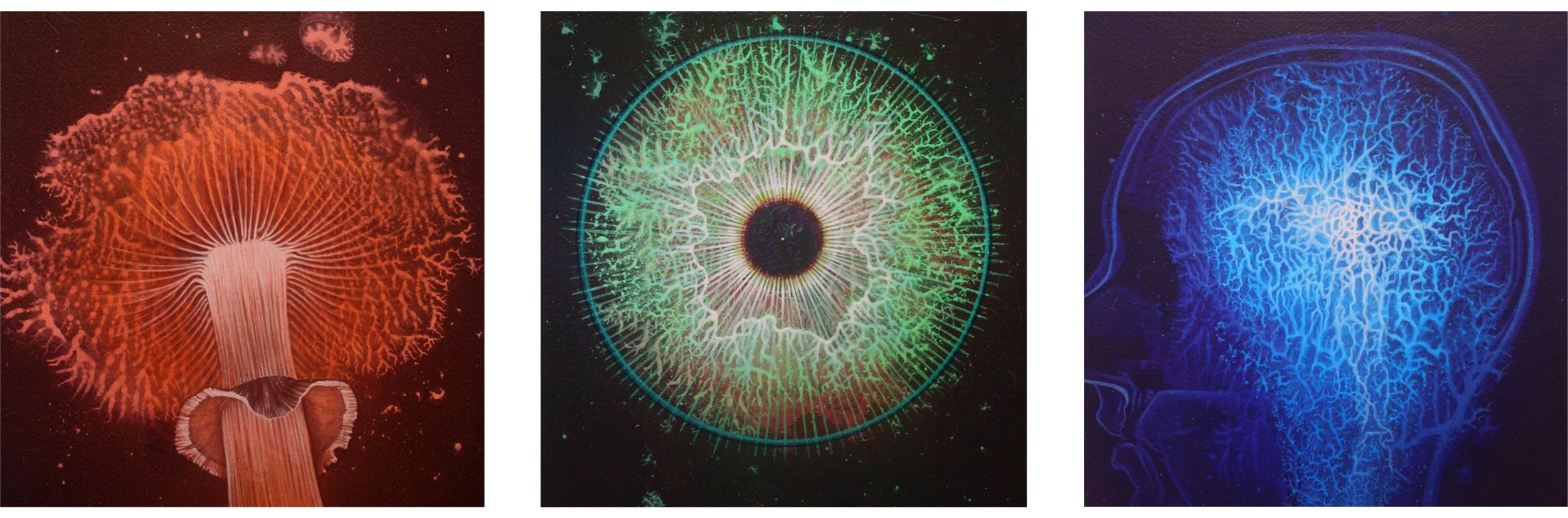
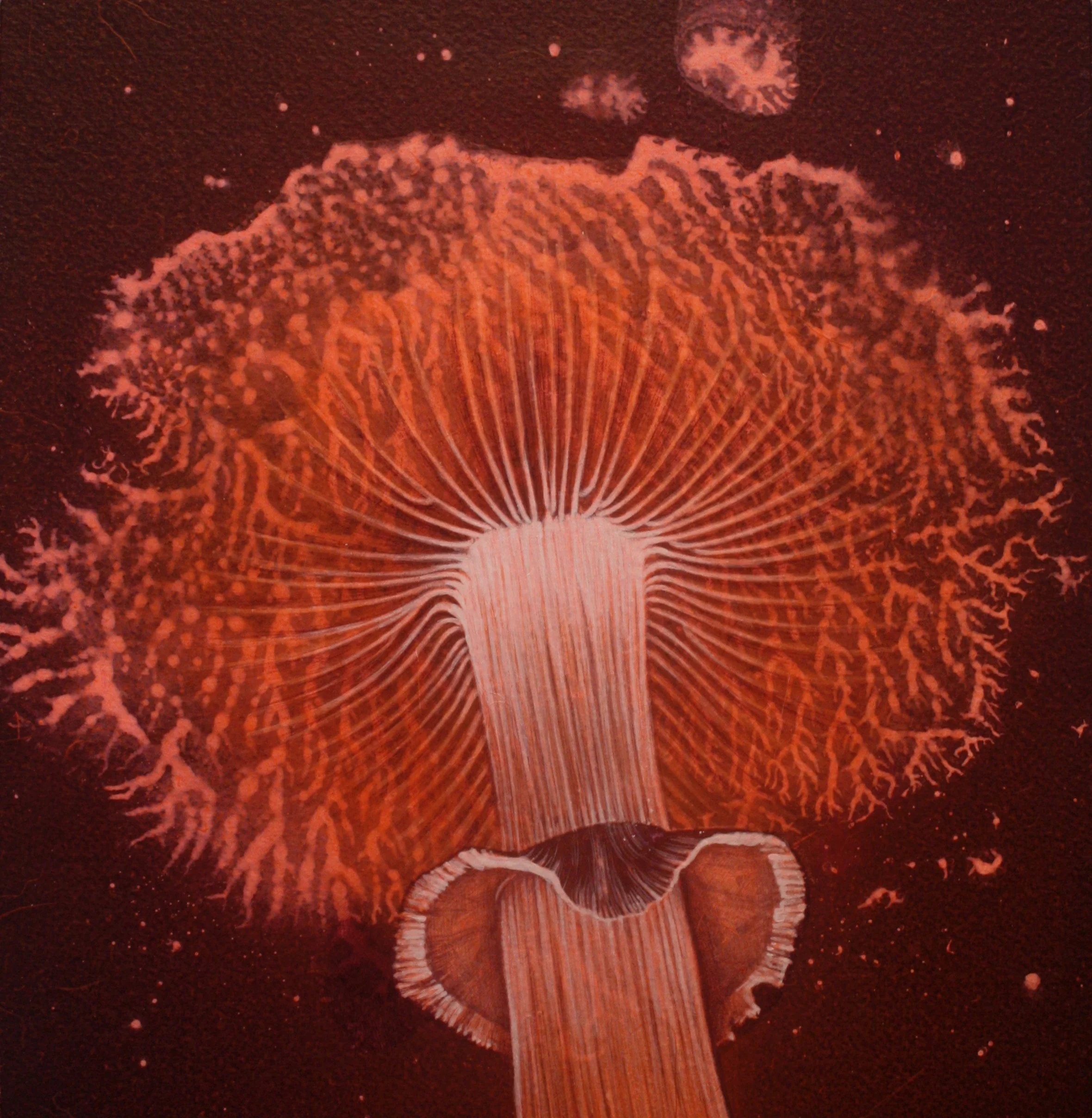
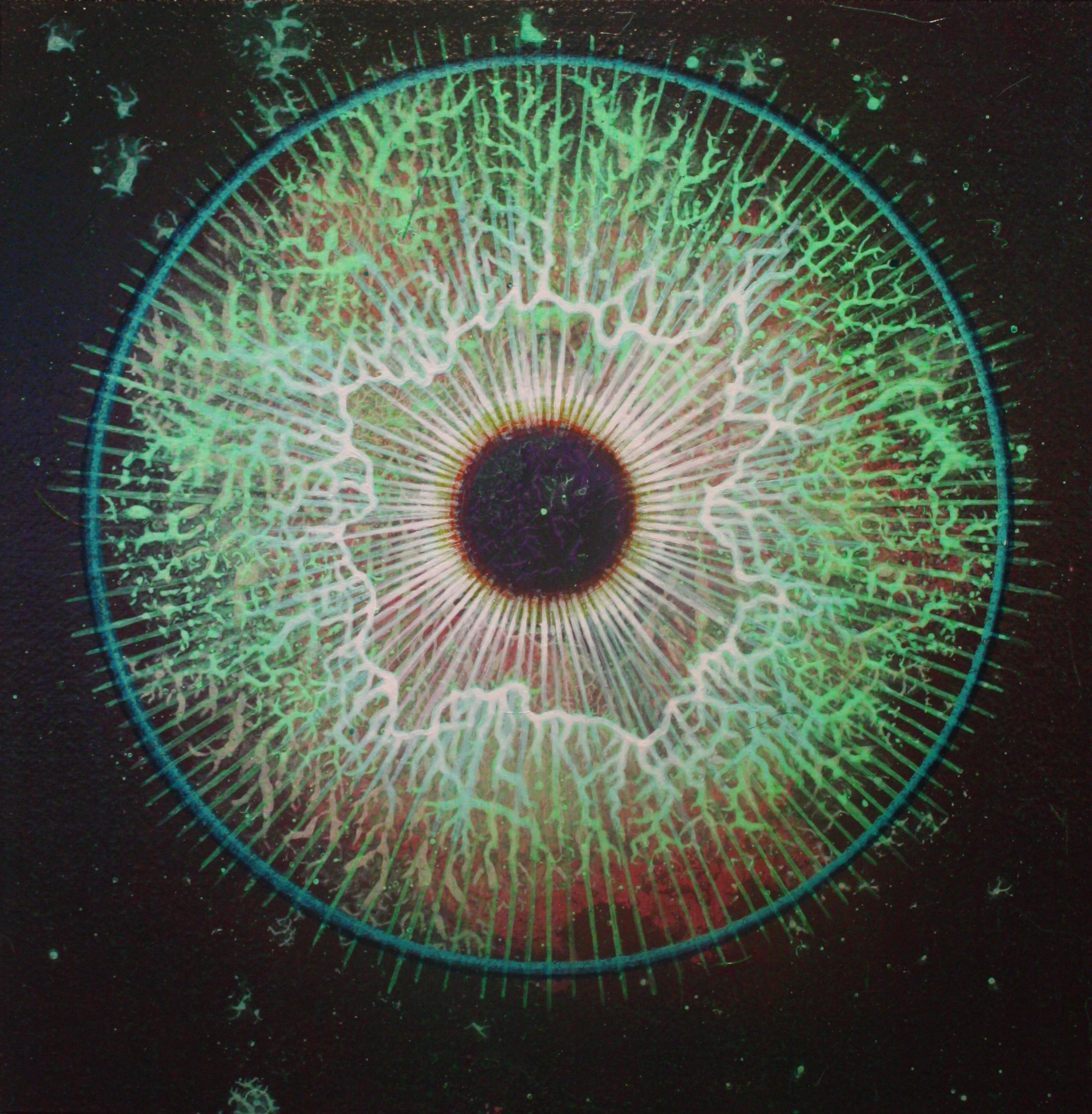
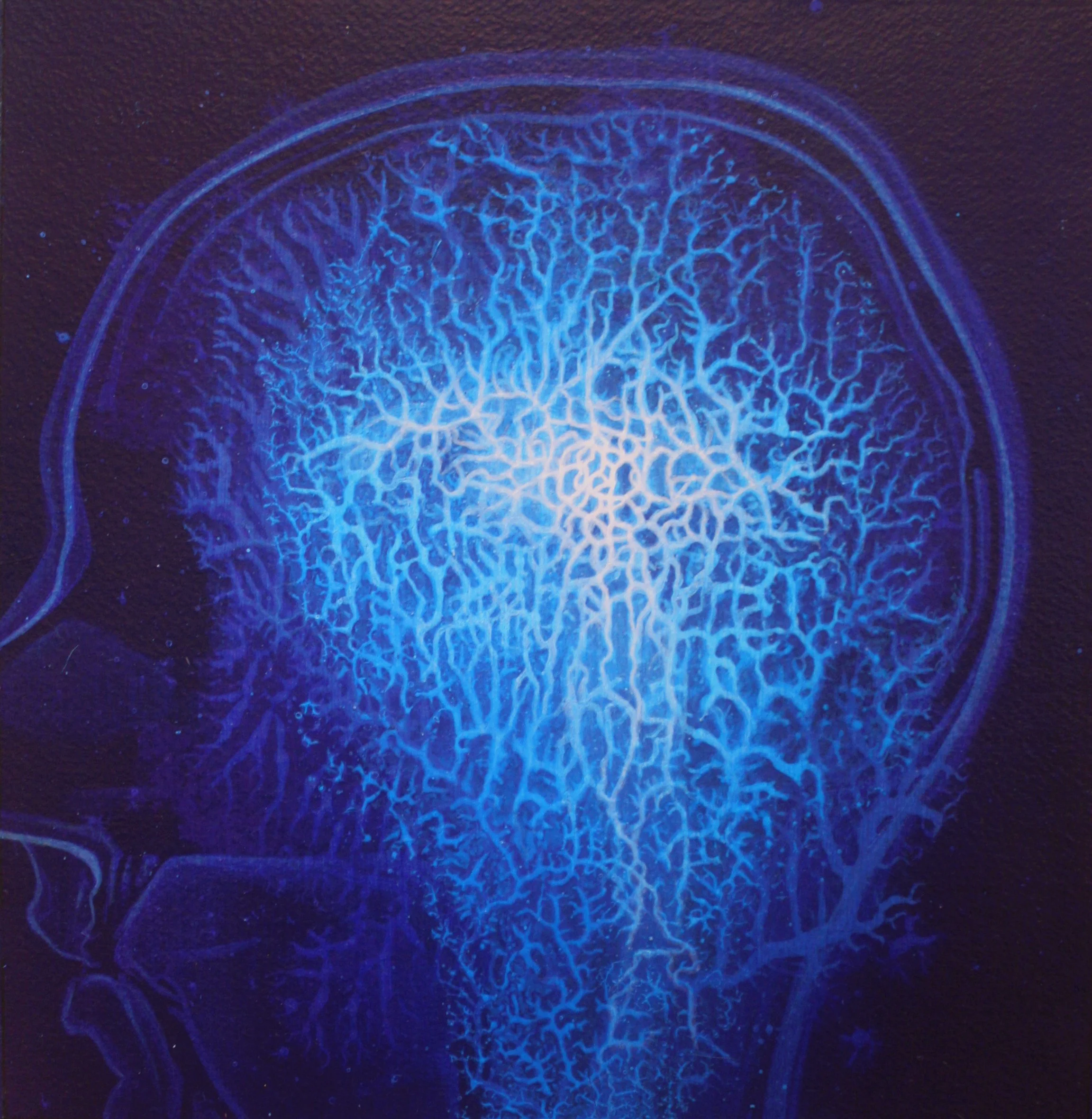
Fungus, Eye, Brain investigates the speculative entanglement between fungi and human consciousness through three interconnected forms: a mushroom, an eye, and a brain. Rather than being conventionally rendered, each image emerges through Leonov’s process of puddle-making, staining, evaporation, and disruption, allowing pigments to branch and coalesce as if guided by their own internal logic. Across the triptych, mycelial structures recur simultaneously as subject, process, and metaphor. The mushroom blooms outward like an underground eruption, the eye radiates through vascular filaments suspended in darkness, and the brain unfurls as a dense network of luminous organic pathways. Cognition is figured not as isolated or linear, but as distributed, ecological, and inseparable from processes of growth and interconnection.
The saturated palette—electric reds, acid greens, and deep blues—emerges from darkened grounds that function less as voids than as spaces of unconscious thought and pre-cognitive potential. Vein-like structures, softened edges, and branching formations blur distinctions between fungal spread, neural circuitry, and systems of perception. In these works, technique mirrors concept: the paintings do not simply depict emergence, they enact it materially through flow, accumulation, and transformation. The triptych form becomes a structure for holding multiple states simultaneously—biological and psychological, microscopic and cosmic, individual and collective—without resolving them into fixed meaning. Through this unstable equilibrium, Leonov extends his broader inquiry into the relationship between material process, perception, and the hidden architectures that shape consciousness itself.