KNOT
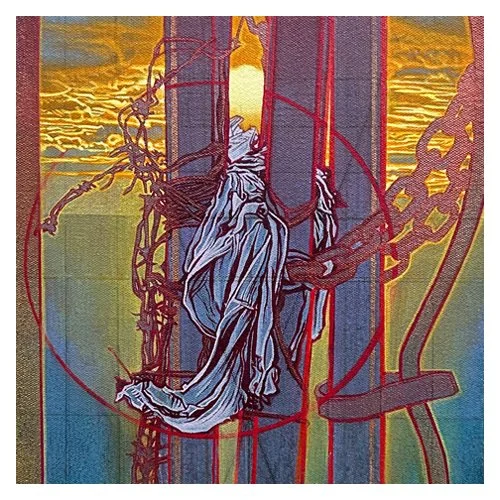
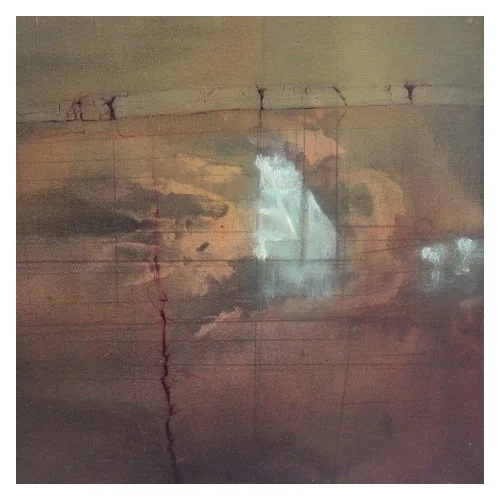
Knot continues Leonov’s investigation into structure as both support and confinement, treating the image itself as a site of entanglement. The title operates simultaneously across its multiple meanings: a compact intersection of interlaced material, a unifying bond, a feeling of constriction, a complex problem, even a swelling within living tissue. Rather than illustrating any single definition, the painting allows these conditions to coexist and overlap, much like the interwoven systems of line, material, and symbol that construct the work itself.
The composition unfolds almost as an internal triptych. A luminous upper register, interrupted by monumental vertical forms, establishes a sense of ascension and architectural order. At the center, chains, suspended fabric-like forms, circular geometries, and taut red vectors converge into the “knot” proper: a dense intersection where burden, containment, and connection become indistinguishable. The draped central form oscillates between body, relic, and material fragment, caught within the very structure that sustains it. Leonov’s recurring tension between organic and geometric systems becomes especially compressed here, with linear scaffolding simultaneously describing, restraining, and binding the image together.
Below, illusion gradually collapses into opacity. Spatial depth cools into layered mineral surfaces where paint, stain, and structural divisions begin to assert themselves over depiction. As in Unreality and Thought Experiment, Leonov treats composition not simply as arrangement but as philosophy made visible: the painting becomes a model for how meaning itself is constructed through tension, overlap, and unresolved states. Knot does not attempt resolution. It stages entanglement as a permanent condition—psychological, material, and existential.
INSIGHT
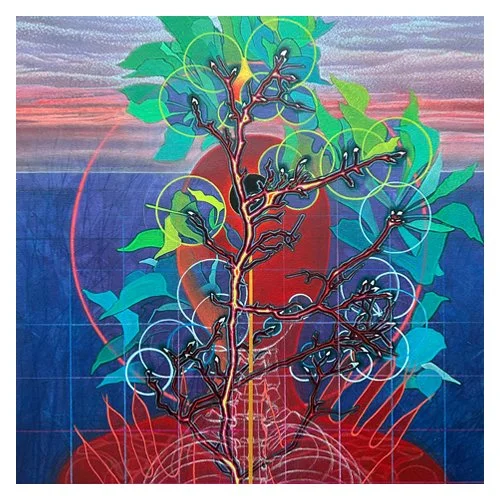
Insight continues Leonov’s exploration of cognition, structure, and interior vision, transforming the image into a symbolic anatomy of thought itself. Rising from the translucent silhouette of the figure is a branching crimson structure that oscillates between tree, vascular system, neural map, and fungal growth. The title becomes essential here: Insight suggests both psychological revelation and literal seeing within, aligning the work with Leonov’s growing engagement with radiologic imagery and systems of internal observation. The figure is not modeled traditionally but exposed through layered structures, as though perception itself were being scanned into visibility.
The painting sustains a deliberate ambiguity between growth and intrusion. The branching form can be read as generative—an image of cognition expanding outward into the world—or as invasive, overtaking the body that produces it. Circular nodes and translucent overlays hover across the surface like cognitive diagrams, synaptic markers, or radiographic annotations, while the spectral hands remain unresolved, preparing a future register of touch, print, and bodily contact. Leonov’s recurring geometries no longer function purely as compositional scaffolding; they become analytical instruments, systems for mapping the invisible relationships between thought, structure, and embodiment.
Formally, Insight advances Leonov’s ongoing shift away from illusionistic depth toward layered transparency and constructed spatial logic. The radiant dusk atmosphere establishes a sense of distance, yet the flat leaves, gridded divisions, and luminous overlays resist settling into stable space. Dimensionality emerges through stacking, glow, and linear accumulation rather than conventional modeling, reinforcing the work’s “X-ray” impulse: seeing through by revealing systems rather than surfaces. In this sense, the painting operates simultaneously as portrait, diagram, and psychological landscape—an image of consciousness rendered as living infrastructure.
THOUGHT EXPERIMENT
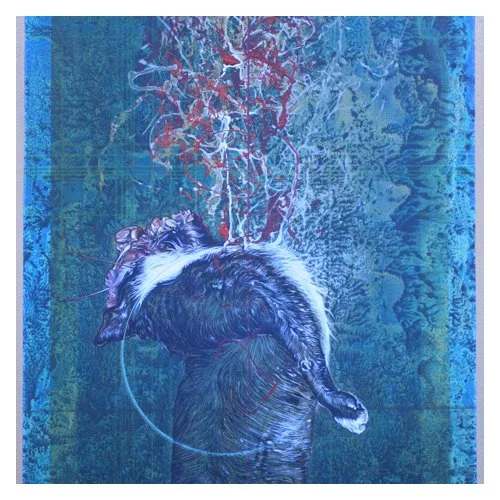
Thought Experiment externalizes the stakes of observation. Centered on a life-sized dead cat suspended within a tightly vertical composition, the painting fixes the viewer in the position of examiner, reinforcing the experimental framework invoked by the title. The overhead perspective evokes the logic of a sealed container or laboratory specimen, transforming the act of looking into an ethical confrontation rather than a neutral encounter. A smaller preparatory study established this structure, condensing the image into its essential tensions before its expansion into the final work.
The painting draws from Schrödinger’s cat and Einstein’s objection to the paradox’s more radical interpretations: reality exists independently of observation, even when human systems struggle to account for it honestly. Leonov translates this conflict through a collision of visual languages. The cat is rendered with meticulous anatomical precision, carrying the weight of classical observation and bodily fact, while above it an explosive field of tangled red, white, and linear structures recalls the ruptures of abstraction, scientific uncertainty, and twentieth-century systems of thought. Art history and science become both subject and method: realism confronts abstraction, the body confronts the model, and observation confronts the violence hidden within frameworks of knowledge.
The work also resonates with the ethical terrain invoked in Skinny Puppy’s Testure: the use of animal bodies within systems of experimentation, control, and abstraction. Grids, circular forms, and measured divisions reassert containment across the surface, while the cool blues and greens evoke scientific imaging or forensic documentation. Observation here is not passive; to look is to participate in the collapse of uncertainty into fact. In this shift from inward psychological inquiry toward external ethical reality, Thought Experiment marks a pivotal expansion in Leonov’s practice.
CIRCULATION
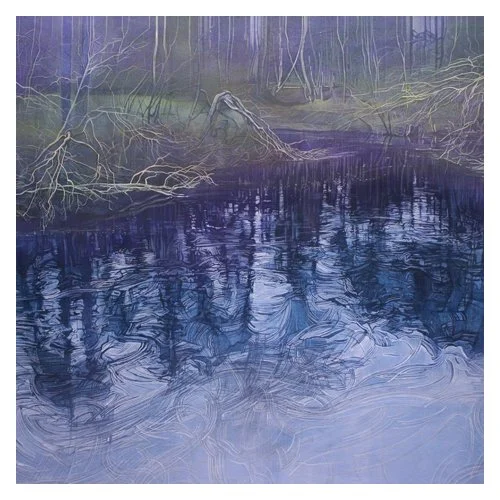
In Circulation, Leonov reduces his visual language to expose the structural mechanics of perception itself. The painting centers on a quiet forest stream, yet its true subject is the unstable boundary between observation, memory, and abstraction. The composition unfolds through a vertical progression of spatial states: the upper register retains atmospheric depth and recognizable landscape, the central waterline fractures reflection into dense rhythmic distortions, and the lower section gradually abandons depiction altogether, allowing line and surface to assert their autonomy.
The reflective surface becomes the work’s central mechanism. Trees, branches, and light are not simply mirrored but translated into layered currents of looping marks that oscillate between natural observation and pure structural drawing. Leonov paints white over a dark ground, producing an inverse luminosity that makes the image feel illuminated from within rather than externally lit. This reversal reinforces the painting’s concern with perception as an active construction rather than passive recording. The lower portion no longer describes water convincingly; instead it reveals the anatomy of representation itself, where gesture, rhythm, and accumulated linear movement become the subject.
Unlike works dense with symbolic confrontation, Circulation achieves tension through restraint. The subdued blues and violets suppress overt emotionality, while the persistent repetitions of branching and reflective patterns connect the landscape to Leonov’s broader investigations into organic systems, memory, and structural recurrence. Here the technical process itself becomes the conceptual focus: observation dissolves into pattern, pattern into mark, and mark into surface. The painting ultimately functions as both landscape and diagram of perception, tracing how experience circulates through memory, structure, and the act of looking.
UNREALITY
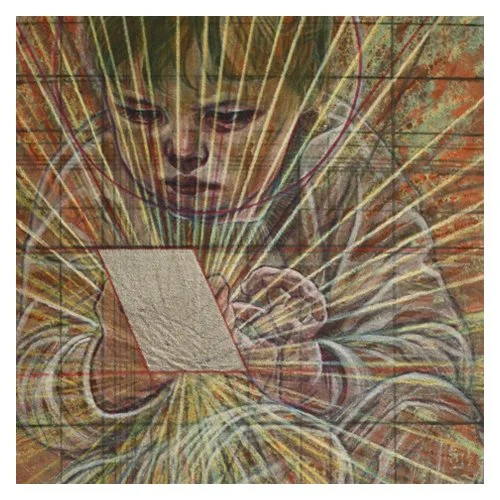
Unreality addresses early technological capture by converting format into content. The canvas itself adopts the proportions of a smartphone, implicating the viewer in the familiar act of holding and looking, while the child’s absorbed gaze establishes a condition of withdrawal from the surrounding world. The screen, rendered as a cold metallic rectangle, resists absorption into the body and becomes a blank site of projection: radiant, empty, and structuring.
Radiating lines extend from the device across the figure, transforming classical perspective into an optical cage. What might once have organized depth or harmony now operates as a system of containment, tightening around the child through grids, beams, and sharp spatial divisions. The halo is reinterpreted as digital enclosure, replacing organic or spiritual wholeness with a formatted field of attention.
Rather than moralizing technology, Unreality examines the structures through which artificial experience becomes normalized. The painting positions the device not simply as an object, but as a system shaping perception at its most formative stage. In this shift from sphere to rectangle, from presence to interface, Leonov gives visual form to a contemporary condition in which connection, attention, and reality itself are increasingly mediated by the screen.
FUNGUS-EYE-BRAIN (triptych)
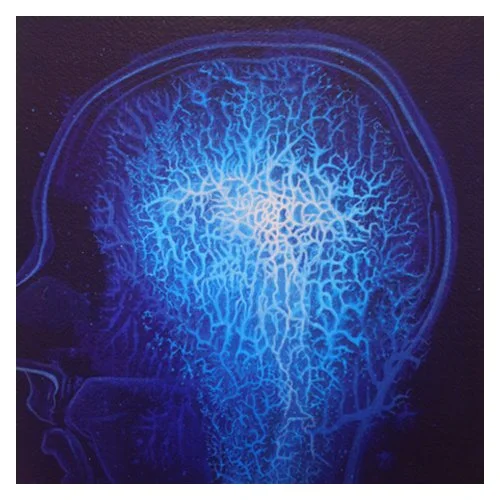
Fungus, Eye, Brain investigates the speculative entanglement between fungi and human consciousness through three interconnected forms: a mushroom, an eye, and a brain. Rather than being conventionally rendered, each image emerges through Leonov’s process of puddle-making, staining, evaporation, and disruption, allowing pigments to branch and coalesce as if guided by their own internal logic. Across the triptych, mycelial structures recur simultaneously as subject, process, and metaphor. The mushroom blooms outward like an underground eruption, the eye radiates through vascular filaments suspended in darkness, and the brain unfurls as a dense network of luminous organic pathways. Cognition is figured not as isolated or linear, but as distributed, ecological, and inseparable from processes of growth and interconnection.
The saturated palette—electric reds, acid greens, and deep blues—emerges from darkened grounds that function less as voids than as spaces of unconscious thought and pre-cognitive potential. Vein-like structures, softened edges, and branching formations blur distinctions between fungal spread, neural circuitry, and systems of perception. In these works, technique mirrors concept: the paintings do not simply depict emergence, they enact it materially through flow, accumulation, and transformation. The triptych form becomes a structure for holding multiple states simultaneously—biological and psychological, microscopic and cosmic, individual and collective—without resolving them into fixed meaning. Through this unstable equilibrium, Leonov extends his broader inquiry into the relationship between material process, perception, and the hidden architectures that shape consciousness itself.
CAVE
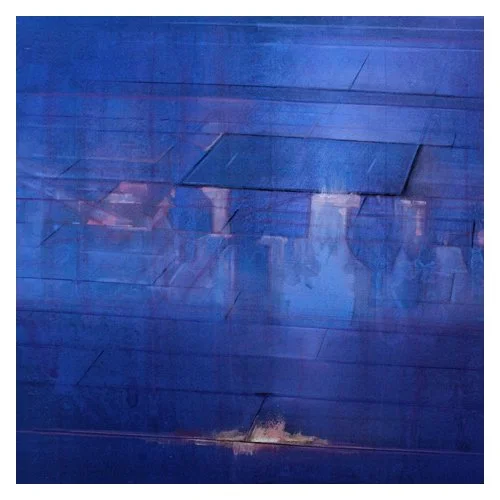
Cave draws from Plato’s Allegory of the Cave, transforming the philosophical metaphor into a contemporary and deeply personal image of perception, confinement, and mediated experience. The painting depicts the reflected movement of figures entering and exiting a subway through layered handprints embedded into the surface, collapsing bodily presence, memory, and illusion into a single unstable field. These imprints recall both Paleolithic cave markings and the repetitive traces of urban existence, positioning the hand simultaneously as evidence of presence and a sign of entrapment within constructed systems.
The composition operates through reflection rather than direct depiction. Figures appear fragmented and partially dissolved across the dark blue surface, as though suspended between apparition and erasure. The tiled geometry of the floor introduces a rigid spatial order, while the blurred movement of bodies and the spectral quality of the handprints destabilize it. In this tension, Leonov extends his ongoing inquiry into the relationship between the sensible and the intelligible: the visible world becomes a shifting projection rather than fixed reality.
Rather than illustrating Plato directly, Cave translates the allegory into lived contemporary experience. The subway functions as a modern passageway of repetition and conditioned movement, where human presence becomes absorbed into systems larger than itself. The work marks an important emergence of Leonov’s “human disease” framework, where geometry, reflection, bodily trace, and philosophical structure converge into a meditation on alienation, memory, and the fragile possibility of self-awareness within constructed realities.
DIVIDED LINE (series)
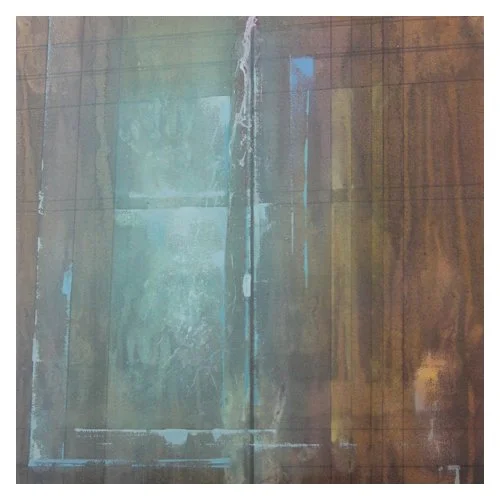
Divided Line is a meditation on memory, perception, and philosophical ascent, rooted in Leonov’s repeated passage from the St. Petersburg subway station to his childhood apartment—a route revisited so persistently through memory, dreams, and lived experience that it became both psychological landscape and metaphysical structure. The series draws directly from Plato’s Allegory of the Cave and Divided Line, transforming ordinary urban movement into a progression through states of consciousness. Escalators, tunnels, railings, wires, and corridors operate not simply as architectural motifs, but as symbols of entrapment within the sensory and material realm.
Across the four paintings, multiple progressions unfold simultaneously. Spatially, the works shift from atmospheric depth toward increasing flatness and structural compression. Visually, indistinct environments gradually resolve into traces of human presence: reflections, shadows, and ultimately the apparition of the figure itself. The string embedded into the canvases acts as a literal manifestation of Plato’s divided line—a physical threshold separating illusion from understanding, sensation from knowledge. Light becomes equally symbolic: natural illumination falling across industrial surfaces reveals the tension between organic existence and artificial systems constructed to contain, direct, and regulate human movement.
At the core of the series lies Leonov’s developing conception of the “human disease”: the condition of alienation produced by mistaking material appearances for reality itself. The paintings suggest a civilization increasingly enclosed within its own structures—psychological, architectural, and ideological—constructing systems meant to liberate while ultimately inhabiting them as cages. Yet Divided Line does not propose enlightenment as resolution. Instead, realization emerges as painful self-awareness: the recognition of one’s place within broader systems of memory, perception, desire, and collective existence. Through layered surfaces, spatial disorientation, and restrained figuration, Leonov transforms personal recollection into a broader philosophical inquiry into how human beings navigate the unstable boundary between essence and material form.
DIVIDED LINE (intro)
The two introductory paintings establish the conceptual and methodological foundation for Divided Line. Rather than functioning as preliminary sketches in a traditional sense, they operate as testing grounds where narrative, material process, and philosophical structure begin to merge into a unified visual language. Here Leonov’s emerging notion of the “human disease” first becomes materially embedded: surface treatment, spatial construction, and symbolic imagery are inseparable from the psychological and existential conditions the works investigate.
Architectural fragments, dim passages, reflected light, and suspended linear elements appear as both remembered spaces and states of mind. The paintings explore how methodology itself can carry meaning—through layered transparencies, abrasive surface shifts, string interventions, and the tension between illusionistic depth and flattening abstraction. These strategies would become central throughout Leonov’s later practice, where formal systems no longer illustrate ideas, but actively generate them.
DEPARTURE
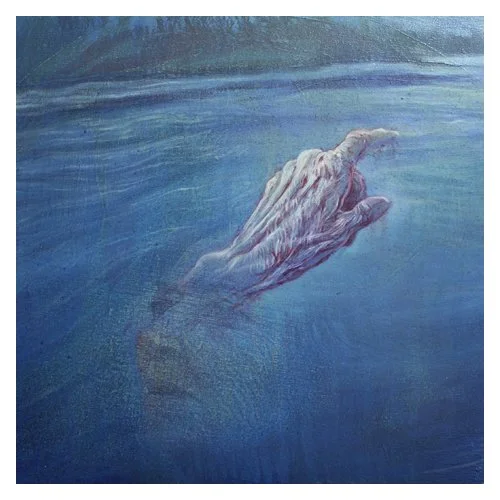
Departure reflects on memory, time, and the instability of perception through the experience of revisiting a place transformed by time. Prompted by a visit to Leonov’s grandmother’s childhood home, the work examines the dissolution of spatial familiarity and the fragmentation of recollection, where direct experience becomes entangled with inherited memory. The painting centers on a hand derived from a portrait created two years earlier, extending through a fluid, indeterminate environment in which surface, reflection, and atmosphere begin to merge. Beneath it, a faint visage emerges and recedes simultaneously, suggesting memory as something continually forming and disappearing at once.
Rather than depicting a specific narrative, Departure focuses on the psychological distortion produced when reality confronts its remembered image. The work developed alongside Detach, sharing its concern with estrangement, temporal distance, and the unstable relationship between material place and emotional residue. Through subtle layering, submerged figuration, and restrained shifts in surface, Leonov constructs a space where perception itself becomes uncertain —where presence, absence, and recollection remain suspended in continuous transition.
DETACH (series)
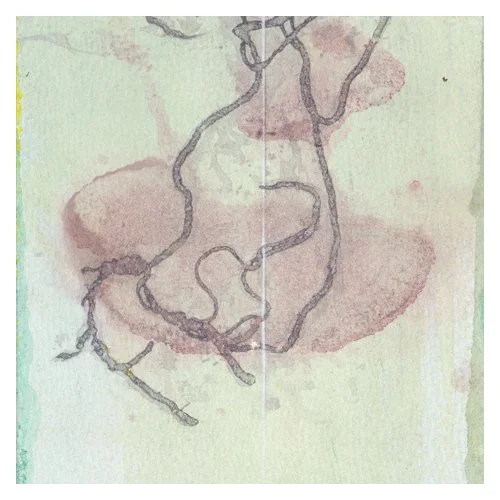
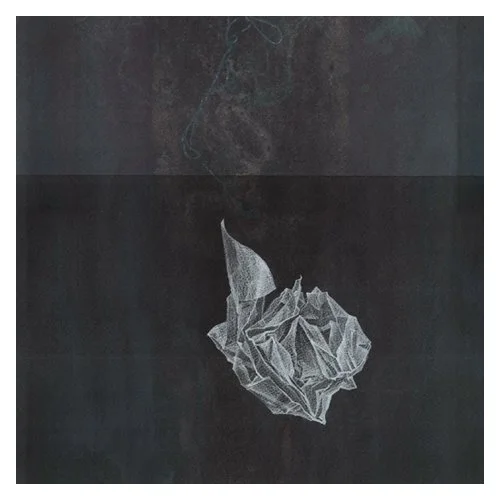
Detach emerged during Leonov’s final visits to Russia, continuing the experimental momentum of the Modus Operandi sketchbooks while shifting toward a more defined inquiry into memory and release. Initially intuitive and open-ended, the works gradually absorbed events, images, and emotional residue from that period, forming a fragmented, non-linear account of separation from place. Rather than documenting Russia directly, the series approaches place as something unstable: partially remembered, partially estranged, and increasingly inaccessible in material form.
Across the drawings, landscape, architecture, portraiture, handwritten text, diagrammatic line, and organic abstraction are each resolved through different formal means, yet held within a shared atmosphere of fading, suspension, and distance. The central concern becomes the necessity of releasing a material place while acknowledging the persistence of its essence in memory. Time and space converge, but once the moment has passed, only its immaterial residue remains; the site itself becomes alien. In this tension between the sensible and the intelligible, Detach renders fragmented memory not as loss alone, but as a condition through which image, distance, and self-awareness continue to form.
POSESSION (triptych)
In Possession, Leonov constructs a process-oriented triptych centered on the human impulse to influence, control, and consume the surrounding environment. Across the three panels, organic and constructed systems enter into gradual conflict: the structure of wood is interrupted by bodily trace, abrasion, and accumulations of surface activity that feel both intimate and destructive. The works unfold less as narrative images than as states of transformation, where touch becomes a mechanism of alteration and erosion.
Central to the triptych is the development of “fleshmaps” — Leonov’s use of skin texture and bodily imprint as a connective visual language. These traces link forms across different scales: fingerprints echo wood grain, surface abrasion resembles topographic drift, and the body itself becomes inseparable from the processes acting upon the environment. Through restrained palette, layered surface, and subtle spatial divisions, Possession becomes a meditation on impermanence, self-awareness, and the unstable boundary between human presence and material decay.